For many, many years I was TOO sad to watch a Swayze movie because I miss him SO much. But this year, I’m swinging in the other direction. This is also my 500th post (!!) and we’re coming up on the blog’s 7th anniversary (!!!) so I want to do something big to celebrate. Very Special Readers, Welcome to the Summer of Swayze.
It’s a little like this but with more mullets and more Jennifer Grey. But it will include a lot of sitting around and watching TV, so I think George Costanza would approve.
I’m really excited to share this line-up with you.
–M*A*S*H – “Blood Brothers“ –The Outsiders –Red Dawn –Dirty Dancing –Road House –Ghost –Point Break –To Wong Foo Thanks For Everything, Julie Newmar –Dirty Dancing: Havana Nights
In the meantime, feast your eyes on a young Patrick Swayze dancing in Toto’s “Rosanna” music video. Swayze’s the one in the red jacket (until he takes it off at 04:15).
Released in February of 1989, Her Alibi earned a whopping half-star rating from Roger Ebert and lead actress, Paulina Porizkova, was nominated for a Razzie.
“This movie is desperately bankrupt of imagination and wit, and Tom Selleck looks adrift in it. He plays a detective novelist, named Blackwood, who has run out of inspiration. So he goes to criminal court for fresh ideas, and there he falls instantly in love with Nina (Paulina Porizkova), a Romanian immigrant who is accused of murdering a young man with a pair of scissors. Blackwood disguises himself as a priest, smuggles himself into jail to meet Nina, and offers to supply her with an alibi: She can claim they were having an affair at his country home in Connecticut at the time of the crime.” — Roger Ebert in his review of Her Alibi (1989)
As with many negative things in life, the bad reviews are a problem of perspective. Much like I hated Footloose when I rented it from the video store as a thirteen year-old who took all older teenagers very seriously, I loved the movie seven years later when I caught it on television and realized it was hilarious and metaphorical in all the best ways possible. It was also an early sign of a doomed relationship when the guy I was dating at the time negged me for loving it! Pro-tip, only date people who graciously give you the space to love campy things!
Okay, back to Her Alibi. We’re going to approach this from the perspective of literally everything is a joke whether or not the movie is in on it. This starts with the opening credits, which has some Clue-worthy theme music. It also features a lot of fake book titles. If you regularly read this blog, you know I’m already a sucker for that. More importantly, the book titles let you in on a very important aspect of this movie: it isn’t take itself that seriously.
Much of the narration in this film comes from Tom Selleck’s character writing his latest novel in a detective series. The titular detective is “Peter Swift,” reminiscent of Tom Swift from the same syndicate that brought you Nancy Drew and The Hard Boys. These are airport novels with corny titles. The cover that features a football helmet bears the title “The Dying Position.” The one with a theater setting is called “Looks Like Curtains.” My personal favorite features a stained glass window of a nun with a giant syringe in the foreground. It’s called “The Dying Habit.” You get the picture.
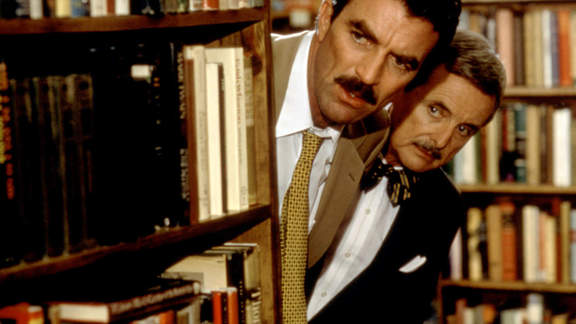
The film opens with a murder in a New York City apartment building. The only leads are that the victim was a student whose downstairs neighbor heard an argument in a “weird language.” Meanwhile, Phil (Tom Selleck) meets with his editor (William Daniels a.k.a. Mr. Feeny) to discuss his four-year long writing dry spell. Shortly thereafter, Phil heads to court where he sits with a group of other writers, eavesdropping on arraignments for inspiration.
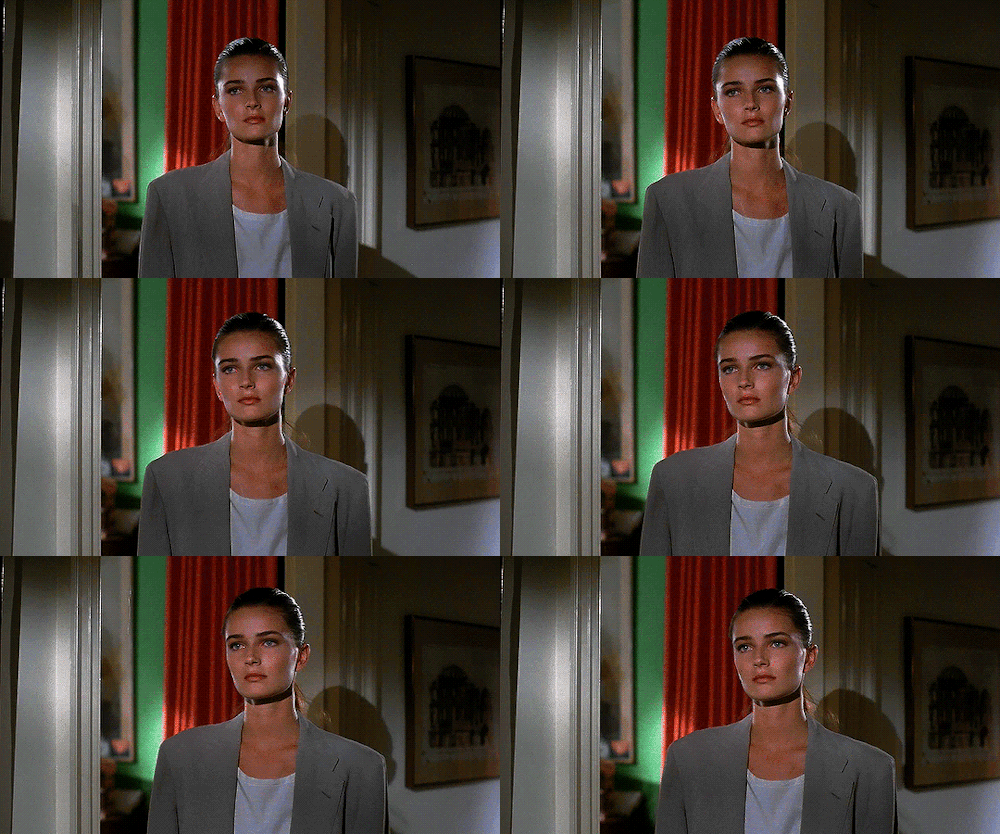
When Nina (Paulina Porizkova) enters the courtroom, Phil develops a crush (and a sudden rush of writing inspiration). There’s just one catch — remember that dead body from just a few minutes ago? They think Nina and a pair of nine-inch scissors are responsible.
Dressed as a priest, Phil visits Nina in jail and offers her an alibi. He will pretend to be her lover and she can come home with him to Connecticut. (They work out this deal while Phil shouts at her across the room with a correctional officer just on the other side of the door. Very stealth.) Understandably, Nina plans to ditch Phil as soon as she is released. Unfortunately, there are a whole bunch of thugs waiting for her as she leaves the jail, so she goes to Phil with Connecticut anyway.
Phil’s Connecticut home is a lovely old farmhouse with lots of vaulted ceilings and stone-facing. True to the promise he made in the jail, he gives Nina the guest room and doesn’t attempt to do anything creepy. He mostly just cooks poorly and writes his novel in his head.
The recurring joke of the movie is that Phil is fairly paranoid, who were it not for the power of lust would probably never take a risk at all. We see this paranoia frequently juxtaposed with Phil’s narration of Peter Swift’s daring exploits. As the night wears on, Phil becomes increasingly terrified of Nina, which is understandable given that she’s an accused murderer who throws a giant knife at his head — to kill a bug.
Isolated in Connecticut, Phil interprets almost everything Nina does as an attempt on his life. He’s so jumpy he falls into the pool while taking out the trash because he catches a glimpse of her through the window. She’s painting her face entirely white. Clearly murderous stuff. But who can’t relate to a(n) (un)healthy dose of paranoia these days?
One day, Nina rides her bike to a local shopping center. While there, she narrowly escapes the thugs from earlier and rushes home to Phil, who is just about to leave for the barber shop. She’s afraid to be alone, so she insists on cutting his hair herself. Phil reluctantly agrees to let her use the presumed murder weapon so close to his major arteries. And we get this sexy haircut scene in return:
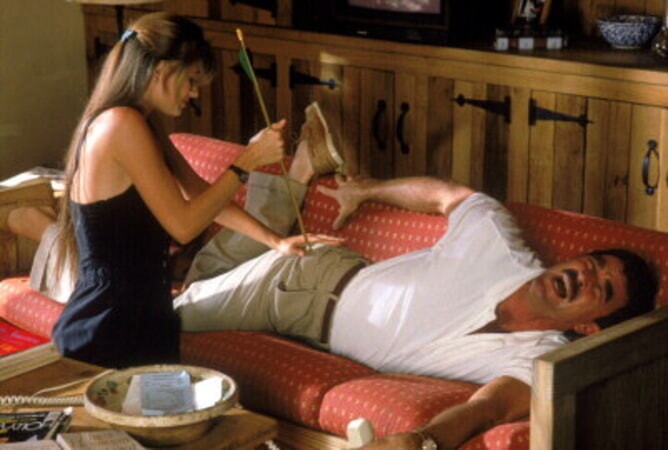
Shortly thereafter, Phil teaches Nina how to use a bow and arrow — you can see his new level of trust after having survived the haircut. Unfortunately, shoots him in the ass. One harrowing drive to the hospital later and Phil is paranoid again.
Eventually, Phil works up the courage to ask Nina point blank if she committed the murder. She refuses to answer. He follows her downstairs and sees her brandishing a pair of scissors through a crack in the door. As Phil attempts to barricade himself in his room, Nina appears behind him with a rose. She was only using the scissors to remove the thorns.
We then learn that Phil’s been in a bit of a rut since his wife left him. And taking an attractive accused murderer home might be some kind of subconscious attempt at DIY exposure-response therapy. So does Phil finally trust Nina? He does until a bomb explodes behind him in the kitchen while Nina is a safe distance away in the pool.
Phil asks a writer friend to use her connections to research Nina’s past. He also begins listening in on her conversations. Unfortunately, the only thing Phil’s able to glean from his pocket Romanian dictionary is that Nina has mentioned something about a funeral.
In the next scene, Nina makes dinner for Phil’s entire family. She says it’s a Romanian custom where the youngest woman makes dinner for everyone and then takes a walk while they eat it. When Nina leaves for her walk, Phil gives a little portion of the food to the cat before the rest of the family sits down for dinner.
As it turns out, Nina’s walk consists of fleeing with a friend in a car. Meanwhile over dinner, Phil laughs with his family about all the times he thought Nina had tried to murder him. He then goes to the kitchen and finds the cat, dead. He returns to the table and announces that Nina poisoned them all, but the family thinks it’s another joke. The cat’s dead body quickly proves otherwise.
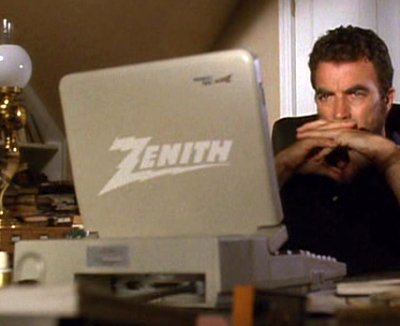
As the family heads to the hospital, Nina returns to the house so that she can tell Phil the truth about everything — which you may have guessed does not include poison. Alone with Phil’s laptop, Nina reads the novel he’s been writing.
Just as the family arrives home after having their stomachs pumped, a neighbor approaches and explains that his wife saw the cat get electrocuted outside and left its body by the door so as not to interrupt their dinner. Nina then confronts Phil for depicting her as a murderer in his new novel and leaves him for good.
Phil later learns from his contact that Nina’s family of famous acrobats has disappeared in the United States after trying to defect from Romania. It turns out the “funeral” from Nina’s phone call is The Funeral of Grimaldi.
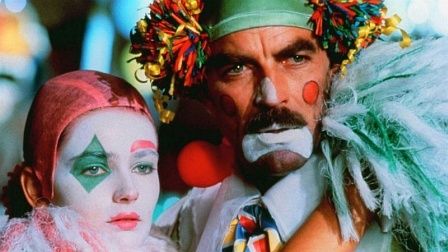
Dressed as a clown, Phil finds Nina at the funeral. This must be sort of a Sandy/Danny at the carnival moment because they both instantaneously overcome their trust issues. They’re chased by the Romanian thugs but fight them off just in time for the lead detective to show up. And good news: Nina’s family’s asylum has been approved! Oh and that dead guy from earlier? He was trying to help them to defect and wasn’t as lucky as Nina and Phil when it came to escaping the thugs.
And what good 80’s movie doesn’t roll credits with a Randy Newman song?
This movie is not quite suspense, not quite romantic comedy (though it’s probably trying to be both). Think of it as a TV movie version of Romancing the Stone. Whether or not you like this movie really comes down to whether or not you’ll get a laugh out of Phil’s corny narration because his novel truly is terrible. Personally, I find tight shots of Tom Selleck mixing a chocolate milk while his voice over says “Swift poured himself a bourbon” to be nothing short of hilarious.
This post is part of the Third Annual So Bad It’s Good Blogathon. For the full roster of posts please click here.
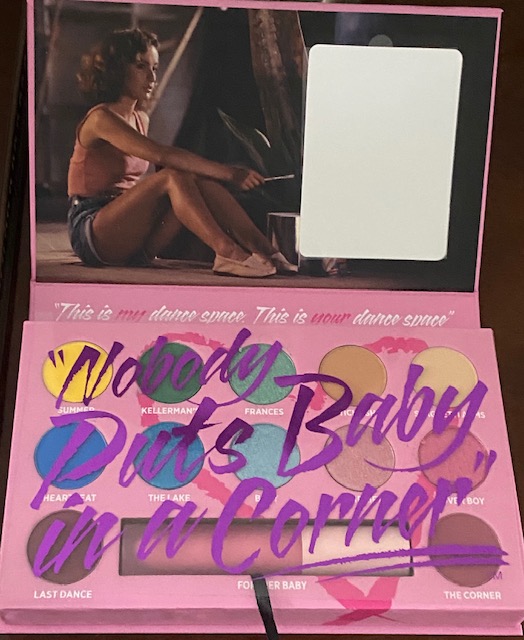
I do not know what it is about this quarantine, but I must have bright colors and I must have them now! I also must have lost my damn mind because I do not remember spending $38 on a palette. It’s a super cute palette, but I think I got caught up in the branding. I wear eyeshadow literally thrice a year.
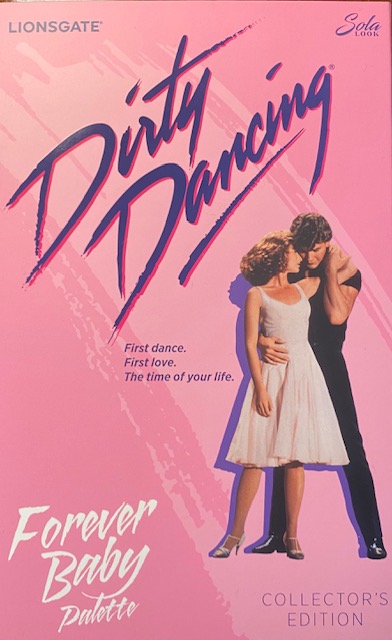
Anyway, this palette is “Forever Baby” from Sola Look (the people who brought you the Grease palette). Okay yes, it’s all coming back to me now. They got me with the nostalgia. The packaging looks like an old school VHS tape. My #1 criticism is that there is no watermelon color, but further research tells me that this was included in a retired palette that I missed the boat on. In that case, my new #1 criticism is that they went with “heartbeat” instead of “hungry eyes” for an eye shadow color name. Come on! Otherwise, it’s perfect in every way.
Also bonus points for some truly 80’s colors in here. You could 100% recreate Joan Cusack’s working girl shadow with this.
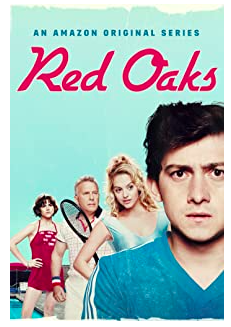
Okay, so I know I ragged on Netflix the other day, but honestly I do love them. They’ve helped me cut the cable cord and for that I’ll always be immensely grateful. But lately, I’ve been trying to give Amazon’s original programing a chance too. I really enjoyed Transparent, so I thought I would give Red Oaks a whirl.
Red Oaks is a coming-of-age summer tale about a suburban college kid. It’s a story you’ve heard 200 times before, but the characters are intriguing and the writing is pretty funny. Jennifer Grey is in it and I’ll love her forever even with her new weird-nose. Also, this show is pretty. The clothes have fantastic colors and the hair is fun. They even have one character with a Molly Ringwald cut (but she throws more of an Ally Sheedy vibe). Suffice it to say, it’s not all big perms.
While I think you should check the whole-thing out, the 7th episode of the season really sings to me. And while it’s not a bottle episode, it does stand a bit alone from the rest of the series so I think I can share it with you without too many spoilers.
David (played by Craig Roberts who I’ve only ever seen in this show) is with his family at one of those Benihana type restaurants, celebrating his father’s birthday. (Dad is played by Richard Kind, who you’ve probably seen in literally everything but most recently Inside Out where he made everyone cry in his riveting performance as Bing-Bong). Things get weird when the sample some Asian liquor.
Pretty earlier on in the series (like first 10 minutes) we learn that David’s parents are in a loveless marriage, and it quickly becomes apparent that many of David’s current decisions are based not wanting his parents’ future. So when I read the episode description for “Body Swap” and realized that David and his father would literally be swapping bodies, I rolled my eyes. Come on!We’ve seen this so many times since the original (and amazing) Freaky Friday. The 80’s were full of lame body/brain switching: Like Father Like Son, Vice Versa, 18 Again, and even to some-extent Dream a Little Dream and Big.
But then I realized that this over-inundation of fish-out-of-water films is exactly why this show decided to step outside of their standard-fare. It doesn’t get more meta than literally transforming into the type of dramady popular in the time period of your show within the context of your show. It’s kind of like, well maybe there were so many of these movies in the 80’s because this was a real problem.
Or for those of you who don’t want to read so deeply into meta-think, this is a really great pastiche. This body-swap isn’t played for laughs…at least not anymore-so than the natural humor this situation creates for the viewer. This isn’t a gimmick and in some ways it gets more real than any of those 80’s movies ever could have. The major conflict of the episode turns out to be that David’s parents’ marriage therapists have instructed them to “Go home. Turn off the TV. Pour some wine. Light a scented candle. And make beautiful, sweet love.” Ick. So that’s the worst possible thing I can imaging happening in a body-swap situation.
So David and his dad are left scrambling to track down a bottle of the weird Japanese liquor made of “humpback” that they drank the night before swapping bodies. Of course, they gain a greater understanding of one-another along they way. (And right when they gain that understanding, the man who originally gave them the liquor mysteriously appears again…)
In 25-minutes Red Oaks fully steps into an 80’s movie trope without sabotaging the original narrative it is establishing for itself. With all of these new quirky, yet heartfelt comedy-dramas, it’s hard to determine what will be a cool show and what will try too hard (looking at you, Scream Queens). But effectively pulling off a pastiche to an entire sub-genre of films is a pretty good sign. It means the writers are more self aware of their show, their context, and their viewers than the first few episodes could demonstrate. And that’s a really, really good sign.
P.S. this episode was directed by Amy Heckerling, so I don’t know how to any further convince you of it’s excellence.








 The Very Special Blog